Showing posts with label Trucks. Show all posts
Monday, June 8, 2009
Wednesday, June 3, 2009
Driving Impresssions
When people go to a car show it's not a full body experience. Not that everyone is tripping because of the fumes that may be present but they aren't soaking up all the cars have to offer. To do that one must drive the vintage machinery.
While at a car show people enjoy:
The important thing is to drive the vehicle. Getting a ride in an old coupe from the guy who has owned it for 50 years doesn't count. He's so used to it that it's an extension of himself. The passenger would not notice the subtleties in how the car is reacting to driver input. Sure, they may be bouncing all over the seat and clutching the door since it sounds like a bucket of loose bolts but something is still missing from the experience.
The oldest vehicle I can remember driving was from the late seventies and it had power brakes and power steering. Am I dating myself, yup. Even with all of the playing around with racecars I did in my twenties I never drove an "old car". I've admired cars from the twenties through the sixties since birth and have even ridden in some but never driven such beasts.
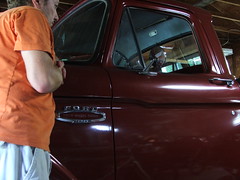
1966 F-100, I-6 300ci, w/factory 4x4
It's a beast.
Things I've learned about driving it:
It is primitive but a blast to drive.
g
While at a car show people enjoy:
- The colors and shapes of the cars with their eyes.
- The sounds of the engines with their ears.
- The smell of non-emission controlled exhaust (with possibly the sweet smell of race gas) with their nose, and of course old cars just smell different.
- The vibration of an open exhaust rumbling past is a whole body sense of touch.
- The unfortunate taste of some old coots cigar you walked to close to when he exhaled.
The important thing is to drive the vehicle. Getting a ride in an old coupe from the guy who has owned it for 50 years doesn't count. He's so used to it that it's an extension of himself. The passenger would not notice the subtleties in how the car is reacting to driver input. Sure, they may be bouncing all over the seat and clutching the door since it sounds like a bucket of loose bolts but something is still missing from the experience.
The oldest vehicle I can remember driving was from the late seventies and it had power brakes and power steering. Am I dating myself, yup. Even with all of the playing around with racecars I did in my twenties I never drove an "old car". I've admired cars from the twenties through the sixties since birth and have even ridden in some but never driven such beasts.
What am I getting at? My truck is finally registered and I have actually driven it someplace at a measurable speed, not just around the yard. I've had it now for over 5 1/2 years and the odometer had read less than 8 miles different than when I bought it. I've hauled wood, leaves, rocks, flower pots and even pulled my barn down with it. None of that prepared me for the "thrill" of driving it on the open road.
1966 F-100, I-6 300ci, w/factory 4x4It's a beast.
Things I've learned about driving it:
- Never start in first gear on pavement, in downtown. You will be hearing the echo of your smokey burnout bouncing of the buildings.
- Once warmed up the smell of leaked oil burning off of the manifold is rather pungent.
- The smell of gas in the closed cab creates headaches.
- The approximation of the steering is a riot. Old steering was never as precise as modern machines, I always wondered why my mother's 1970 Dart needed so much steering input on a straight road, now I know.
- Braking with manual brakes, stops must be planned well in advance.
- Depressing the pedal hard enough will lock up the brakes, put you into a four wheel drift, and stop you in a cloud of smoke.
- At 30mph it's looking for 4th gear.
- The engine will pull and pull and pull.
- The steering wheel is 17 inches in diameter for a reason.
- Downshifting takes patience.
- All of my senses are over loaded when driving it.
It is primitive but a blast to drive.
g
Sunday, May 10, 2009
"I Live for Danger"
This piece of video awesomeness stars three of my coworkers.

Check out The Weather Channel segment "Vortex 2: I Live for Danger"
What makes it awesome?
... so I'll cut and paste the description of the Vortex 2 experiment from their homepage:
VORTEX2 is by far the largest and most ambitious effort ever made to understand tornadoes. We expect over 100 scientists and crew in up to 40 science and support vehicles to participate in this unique, fully nomadic, field program in May/June 2009-2010. The National Science Foundation (NSF) foundation and the National Oceanic and Atmospheric Adminstration (NOAA) together are contributing over $10 million towards this effort. Participants will be drawn from several universities, and several government and private organizations, and will be international including members from Italy, Netherlands, United Kingdom, Canada and Australia.
The basic questions are simple to ask, but hard to answer.
- How, when, and why do tornadoes form? Why some are violent and long lasting while others are weak and short lived?
- What is the structure of tornadoes? How strong are the winds near the ground? How exactly do they do damage?
- How can we learn to forecast tornadoes better? Current warnings have an only 13 minute average lead time and a 70% false alarm rate. Can we make warnings more accurate? Can we warn 30, 45, 60 minutes ahead?
VORTEX2 will use an unprecedented fleet of cutting edge instruments to literally surround tornadoes and the supercell thunderstorms that form them. An armada of 10 mobile radars, including the Doppler On Wheels (DOW) from the Center for Severe Weather Research (CSWR), SMART-Radars from the University of Oklahoma, the NOXP radar from the National Severe Storms Laboratory (NSSL), radars from the University of Massachusetts, the Office of Naval Research and Texas Tech University (TTU), 10 mobile mesonet instrumented vehicles from NSSL and CSWR, 38 deployable instruments including Sticknets (TTU), Tornado-Pods (CSWR), 4 disdrometers (University of Colorado (CU) and U of Illinois), weather balloon launching vans (NSSL, NCAR and SUNY-Oswego), unmanned aircraft (CU), damage survey teams (CSWR, Lyndon State College, NCAR), and photogrammetry teams (Lyndon State Univesity and NCAR), and other instruments.
VORTEX2 is fully nomadic with no home base. Scientists will roam from state to state following severe weather outbreaks through the Plains.
VORTEX2 will hit the road from 10 May - 13 June 2009 and 1 May - 15 June 2010.
Still laughing
g

Check out The Weather Channel segment "Vortex 2: I Live for Danger"
What makes it awesome?
- "Top Gun" reference.
- "Brooklin Hipster" comparison of a South Shore native.
- Red Sox plug....
- Underwear reference.
- The drying of underwear on the radar (actually that might be the only way to sanitize those 2 pair by week 4, way to go Bethany!).
- Those shorts!!!
- Seeing a smart-ass friend on national TV.
... so I'll cut and paste the description of the Vortex 2 experiment from their homepage:
VORTEX2 is by far the largest and most ambitious effort ever made to understand tornadoes. We expect over 100 scientists and crew in up to 40 science and support vehicles to participate in this unique, fully nomadic, field program in May/June 2009-2010. The National Science Foundation (NSF) foundation and the National Oceanic and Atmospheric Adminstration (NOAA) together are contributing over $10 million towards this effort. Participants will be drawn from several universities, and several government and private organizations, and will be international including members from Italy, Netherlands, United Kingdom, Canada and Australia.
The basic questions are simple to ask, but hard to answer.
- How, when, and why do tornadoes form? Why some are violent and long lasting while others are weak and short lived?
- What is the structure of tornadoes? How strong are the winds near the ground? How exactly do they do damage?
- How can we learn to forecast tornadoes better? Current warnings have an only 13 minute average lead time and a 70% false alarm rate. Can we make warnings more accurate? Can we warn 30, 45, 60 minutes ahead?
VORTEX2 will use an unprecedented fleet of cutting edge instruments to literally surround tornadoes and the supercell thunderstorms that form them. An armada of 10 mobile radars, including the Doppler On Wheels (DOW) from the Center for Severe Weather Research (CSWR), SMART-Radars from the University of Oklahoma, the NOXP radar from the National Severe Storms Laboratory (NSSL), radars from the University of Massachusetts, the Office of Naval Research and Texas Tech University (TTU), 10 mobile mesonet instrumented vehicles from NSSL and CSWR, 38 deployable instruments including Sticknets (TTU), Tornado-Pods (CSWR), 4 disdrometers (University of Colorado (CU) and U of Illinois), weather balloon launching vans (NSSL, NCAR and SUNY-Oswego), unmanned aircraft (CU), damage survey teams (CSWR, Lyndon State College, NCAR), and photogrammetry teams (Lyndon State Univesity and NCAR), and other instruments.
VORTEX2 is fully nomadic with no home base. Scientists will roam from state to state following severe weather outbreaks through the Plains.
VORTEX2 will hit the road from 10 May - 13 June 2009 and 1 May - 15 June 2010.
Still laughing
g
Friday, March 20, 2009
Oh New England
March 25, 1998.
The date I picked up my brandy new Exploder from the dealership.
March 20, 2009.
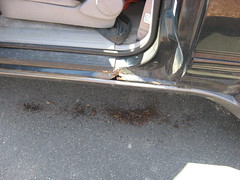
The date I tapped the rocker panel with my foot and most of it flaked to the ground.
Last year I had to take the running boards off because they were starting to wobble. That's when I first saw the cancer. I figured I could stretch a few more years out of it but the inevitable is approaching rapidly. My truck is dying.
So now I'd like to offer my special thanks to:
And after 5 years of owning it, guess who's finally coming out for summer chores?
g
The date I picked up my brandy new Exploder from the dealership.
March 20, 2009.
The date I tapped the rocker panel with my foot and most of it flaked to the ground.
Last year I had to take the running boards off because they were starting to wobble. That's when I first saw the cancer. I figured I could stretch a few more years out of it but the inevitable is approaching rapidly. My truck is dying.
So now I'd like to offer my special thanks to:
- The plastic covers that both caused and hid the rust (it has gotten so far out of hand it can't be fixed).
- The New England states and towns that find it necessary to dump caustic, rust inducing chemicals on the road at the slightest sign of ice because people are to stupid to slow down in inclement weather.
- Stupid people who insist aforementioned product be spread on the ground so they may continue speeding.
And after 5 years of owning it, guess who's finally coming out for summer chores?
Subscribe to:
Posts (Atom)